


SXU Nursing Simulation Professionals Earn New Credential
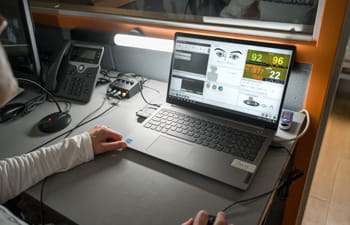
Saint Xavier University (SXU) nursing simulation professionals Jennifer Pietranczyk, Steven Ford, and Kailey Kehoe have earned the Certified Healthcare Simulation Educator (CHSE) credential. Pietranczyk, director of SXU's Simulation and Integrated Learning Center (SILC), Ford, a sim lab technician, and Kehoe, a sim lab assistant, appreciated the opportunity to pursue additional credentials, reflecting their commitment to professional growth and excellence in simulation-based learning.
The Society for Simulation in Healthcare (SSH), an international organization dedicated to advancing healthcare simulation through education, research, advocacy, and professional development, offers professional certifications that recognize expertise and promote high standards in simulation education and operations.
Kehoe, SILC's most senior team member, renewed her CHSE certification this year. Her experience and expertise, particularly in debriefing, are invaluable assets to the team. Debriefing gives students a chance to reflect on their decisions, explore their clinical reasoning, and identify growth opportunities after a simulation experience. Kehoe's continued commitment to professional excellence helps support meaningful learning experiences for SILC students.
Ford, who also earned the Certified Healthcare Simulation Operations Specialist (CHSOS) credential, is dedicated to both the educational and technical aspects of healthcare simulation. With a strong passion for simulation and the technology that supports this teaching approach, Ford helps effectively integrate simulation resources into the learning environment, considering learning objectives, psychological safety, realism, facilitation, assessment, and debriefing so he can ultimately help create simulation experiences that are intentional rather than simply realistic.
"I wanted to challenge myself beyond simply gaining experience in simulation and confirm that I am following standards of best practice. Certification gave me an opportunity to demonstrate that I understand the educational principles and professional standards behind the work we do. It was also important to me personally to continue developing from someone who helps make simulation happen into someone who can contribute to how simulation education is designed and advanced," said Ford.
Ford plans to spend the academic year looking at how he can make the SILC better for learners, including continuing to improve simulation scenarios and debriefing practices, expanding the ways they use different simulation modalities, supporting faculty, and exploring opportunities for research and professional development.
"Long-term, I would love to see the SILC continue developing as not only a place where students come to complete a required simulation but as a resource they actively want to use to prepare themselves for practice. I want students to feel comfortable coming into the SILC to practice a skill, work through something they don't understand, challenge themselves, and build confidence. Ultimately, success isn't about how advanced our technology is or how realistic our simulators are. It is what happens when one of our graduates encounters a difficult situation in practice and realizes, 'I've seen this before. I know what to do.' That's the outcome I hope we continue working toward," added Ford.
Pietranczyk also obtained the CHSE certification this year, which represented the achievement of a long-standing professional goal.
"I have more than 10 years of experience in healthcare simulation and have gained valuable knowledge, skills and professional connections throughout my career. I have worked toward this certification for some time, and I am elated to have achieved it this past year. It represents an important milestone in my professional journey and reinforces my commitment to advancing simulation-based education," said Pietranczyk.
By investing in its team's expertise, SILC continues to strengthen its simulation program and support the preparation of future healthcare professionals.
Simulation has become an increasingly important component of healthcare education, starting with familiar practices such as cardiopulmonary resuscitation (CPR) training and evolving into the immersive learning experiences seen today, using life-sized, lifelike simulators to recreate realistic patient-care scenarios.
These experiences help students practice hands-on clinical skills, strengthen clinical judgment and critical thinking, and build the communication and teamwork skills needed to provide safe, effective patient care. By creating opportunities to learn in a controlled environment, simulation helps prepare future healthcare professionals to navigate the complexities of real-world clinical practice.
The Simulation and Integrated Learning Center (SILC) team at SXU has worked diligently to develop and advance an evidence-based simulation program for nursing and health sciences students. Through strategic equipment acquisitions, learning environment enhancements, the development of evidence-based scenarios, and implementation of the Healthcare Simulation Standards of Best Practice®, the team continues to strengthen the quality and impact of simulation-based education.