


SXU Alumni Collaborate to Pilot First Responders Academy Program
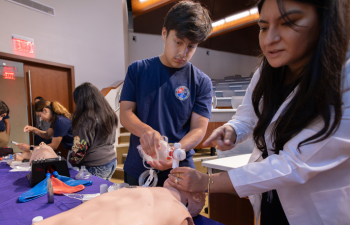
Two Saint Xavier University (SXU) alumni have collaborated to pilot the First Responders Academy program through Northwestern Medicine's partnership with WeGo Together for Kids. Dr. Jessica Muñoz '14 and Janna Eudave '15, who have been friends since their time at Saint Xavier, built the program in an effort to increase Spanish-language representation among first responders and healthcare professionals while expanding career opportunities for local students. The inaugural program involved students from West Chicago Community High School.
Muñoz, who majored in biology at SXU, is now an emergency medicine physician at Central DuPage Hospital, Northwestern Medicine, and Eudave, who majored in business administration, is the program manager of economic and workforce development at Northwestern Medicine. Together, the two have used the skills they gained from their time at SXU and the service mindset they carry from SXU's Mercy mission to create an opportunity that will benefit students and their communities.
Part of Eudave's work is to lead healthcare career exploration programming for local youth by partnering with high schools and community organizations.
"Northwestern Medicine John and Kathy Schreiber Community Health Institute is helping address the complex and systemic causes of health disparities. The institute serves as a unified, strategic platform that brings together clinical excellence, community engagement and data-driven solutions to create lasting change," said Eudave.
As a proud graduate of West Chicago Community High School, Muñoz was excited to return and found it to be incredibly meaningful to be able to provide representation and reach students from Latino and Spanish-speaking families and help them recognize that these careers also belong to them.
During the two-day event, students learned about emergency medicine roles through hands-on activities and classroom lessons. They toured the Mobile Stroke Unit at Central DuPage Hospital, completed Stop the Bleed Training, learned emergency ABCs, practiced intubation on manikins, and learned how to recognize stroke symptoms using the B.E.F.A.S.T acronym. In 2026, the lives of 15,566 youths were touched through Northwestern Medicine's youth educational programming.
Muñoz loved being able to move beyond simply telling students what an emergency physician does and actually let them experience a small part of it.
"Using real medical equipment and a simulation mannequin, I taught students the basics of airway management and gave them the opportunity to practice intubation. Their curiosity was remarkable. They asked questions about strokes, controlling severe bleeding, responding to emergencies, and what any student can do before professional help arrives. Those conversations reminded me that we were teaching much more than career skills. We were teaching confidence. We were showing young people that they are capable of learning how to respond when someone is sick or injured and that they can become the nurses, paramedics, firefighters, physicians, and healthcare leaders their communities need," said Muñoz.
Both Eudave and Muñoz appreciate SXU's mission, which directly aligns with the work they are accomplishing together.
"Through our youth pipeline programs, we strive to inspire, mentor, and educate middle and high school students about the many career opportunities available in healthcare. By providing hands-on experiences, meaningful mentorship, and exposure to healthcare professionals, we help young people see themselves in careers they may not have otherwise considered. What makes this work especially meaningful is our focus on creating equitable access to these opportunities. We intentionally partner with students and schools across our communities to help remove barriers and build pathways to healthcare careers. Through programs like the First Responders Academy, we are not only educating students, but also empowering them to pursue lives of purpose and service to others," said Eudave.
"Rooted in the mission and values of the Sisters of Mercy, SXU taught me that education carries a responsibility. What we learn should ultimately be used in service to others. The University's commitment to service, compassion, social justice and learning for life helped shape the kind of physician and leader I wanted to become. Just as importantly, SXU exposed me to students from different cultures, backgrounds, and life experiences. That diversity challenged me to listen, remain open-minded, and understand that leadership begins with recognizing the dignity and potential of people whose experiences may be different from our own. Those lessons have stayed with me throughout medical school, residency, and now my career in emergency medicine. The Mercy tradition does not end when we receive our diplomas. It lives through graduates who take what they have learned and bring it back into their hospitals, classrooms, neighborhoods and communities. It lives through mentorship, advocacy, compassion and our willingness to hold the door open for the next generation," said Muñoz.
To Muñoz, the inaugural WeGo First Responder Academy represents exactly why such programs matter. Students cannot pursue opportunities they have never been exposed to, and communities with fewer resources should not have fewer pathways for their young people to discover careers in medicine, emergency services and public safety.
"My greatest hope is that years from now, some of the students who participated will return to West Chicago wearing their own scrubs, white coats, firefighter gear or paramedic uniforms and that they, in turn, will reach back for the generation coming behind them. That is how service creates lasting change. For me, that is the legacy of Saint Xavier University and the Sisters of Mercy. We do not simply use our education to build successful careers. We use it to build stronger communities and create opportunities for others to rise with us," said Muñoz.
Northwestern Medicine offers educational programs for students and adults at all stages of workforce readiness. Opportunities include monthly rotations, summer internships, apprenticeships and on-the-job training. To learn more, visit the Northwestern Medicine Workforce Development webpage.